
Introduction: Why In-mold technology defines modern product surfaces
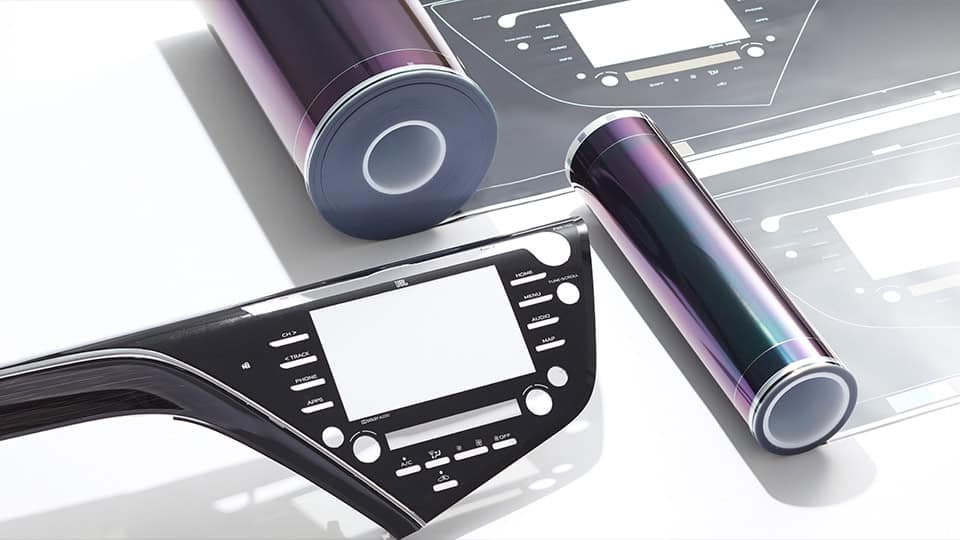
In-mold technology has changed how manufacturers create durable, high-quality, and visually consistent plastic components. Instead of applying graphics or coatings after molding, this advanced process integrates decoration directly into the molded part. As a result, manufacturers achieve superior surface durability, enhanced scratch resistance, and long-lasting aesthetics.
Also known as in-mold decoration (IMD), this method uses a precisely engineered IMD film that becomes part of the final component during film insert molding. Therefore, the surface does not peel, fade, or wear off over time. At Polar Printed Electronics, In-mold technology enables OEMs to combine design flexibility with industrial reliability across multiple applications.
Understanding the structure of an IMD film in In-mold technology
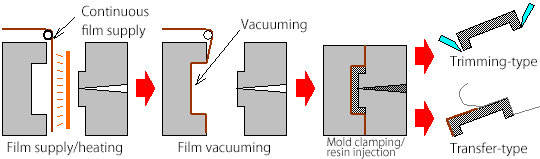
To fully understand In-mold technology, it is important to examine the structure of an IMD film. Unlike traditional surface finishes, an IMD film consists of multiple functional layers. Each layer plays a critical role during molding and throughout the product’s lifecycle.
Typical IMD film layer structure
- Hard-coated film (top layer)
This outer layer delivers excellent scratch resistance and chemical durability. In addition, it protects graphics from abrasion, UV exposure, and cleaning agents. - Decorative or pre-printed film layer
This layer carries graphics, symbols, textures, or metallic effects. A pre-printed film ensures precise alignment and long-term visual stability. - Adhesive or tie layer
The adhesive layer ensures strong bonding during overmolding. Consequently, the film integrates permanently with the injected plastic. - Polycarbonate (PC) film carrier
Polycarbonate (PC) film provides dimensional stability and thermal resistance. It also supports thermoforming for 3D in-mold decoration applications.
Because of this layered construction, In-mold technology delivers both decorative and functional performance in a single manufacturing step.
Material selection in In-mold technology: performance starts here
Material selection strongly influences the success of In-mold technology. Therefore, Polar Printed Electronics carefully selects films and coatings based on application requirements.
Why Polycarbonate (PC) film is preferred
Polycarbonate (PC) film offers high heat resistance, excellent impact strength, and optical clarity. Moreover, it withstands injection molding temperatures without distortion. For complex geometries, PC film also enables reliable film insert molding and 3D in-mold decoration.
Importance of hard-coated film
A hard-coated film significantly improves surface durability. Compared to painted or printed surfaces, hard-coated IMD parts show superior resistance to scratches, chemicals, and repeated use. As a result, manufacturers rely on In-mold technology for high-touch applications.
Printed inks and functional layers
Modern IMD film systems may include UV inks, metallic foils, or functional coatings. These layers remain protected beneath the hard coat, which ensures long-term performance and appearance.
Manufacturing process: how In-mold technology works step by step
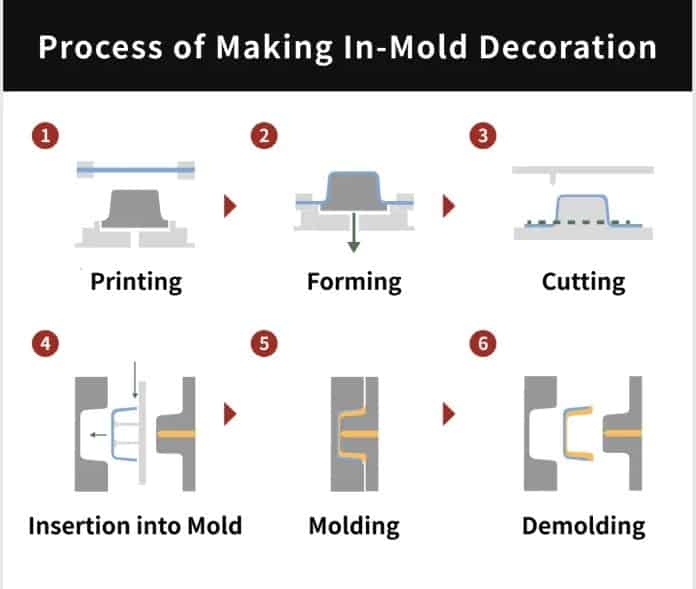
The In-mold technology manufacturing process follows a precise and repeatable workflow. Each stage contributes to part quality and consistency.
Step 1: Film design and printing
Design teams prepare artwork optimized for molding. Next, graphics are printed onto the IMD film using high-precision printing methods. This step defines the final appearance and texture.
Step 2: Thermoforming for 3D in-mold decoration
When components require complex shapes, the IMD film undergoes thermoforming. This step enables 3D in-mold decoration while maintaining graphic alignment.
Step 3: Film trimming and preparation
After forming, the film is trimmed to exact dimensions. Accurate trimming ensures consistent placement during film insert molding.
Step 4: Film placement inside the mold
The prepared IMD film is placed into the injection mold cavity. Automated systems often handle this step to improve accuracy and cycle time.
Step 5: Overmolding and bonding
Molten plastic is injected behind the film. During overmolding, heat and pressure activate the adhesive layer. As a result, the film bonds permanently to the substrate.
Step 6: Cooling, ejection, and inspection
After cooling, the finished part is ejected. Since In-mold technology integrates decoration during molding, no secondary finishing is required.
Key advantages for manufacturers
In-mold technology offers several advantages over traditional surface finishing methods.
- Superior scratch resistance due to hard-coated film
- High design flexibility with complex graphics and textures
- Reduced manufacturing steps, lowering production cost
- Improved durability, since graphics never wear off
- Consistent quality across high-volume production
Because of these benefits, manufacturers increasingly replace painting and labeling with in-mold decoration (IMD).
Design flexibility enabled by IMD and film insert molding
One of the strongest advantages of In-mold technology is design flexibility. Designers can integrate logos, textures, metallic effects, and transparent windows directly into the part.
Additionally, film insert molding supports seamless transitions across curved surfaces. Therefore, designers achieve premium aesthetics without compromising durability or manufacturability.
Applications of In-mold technology across industries
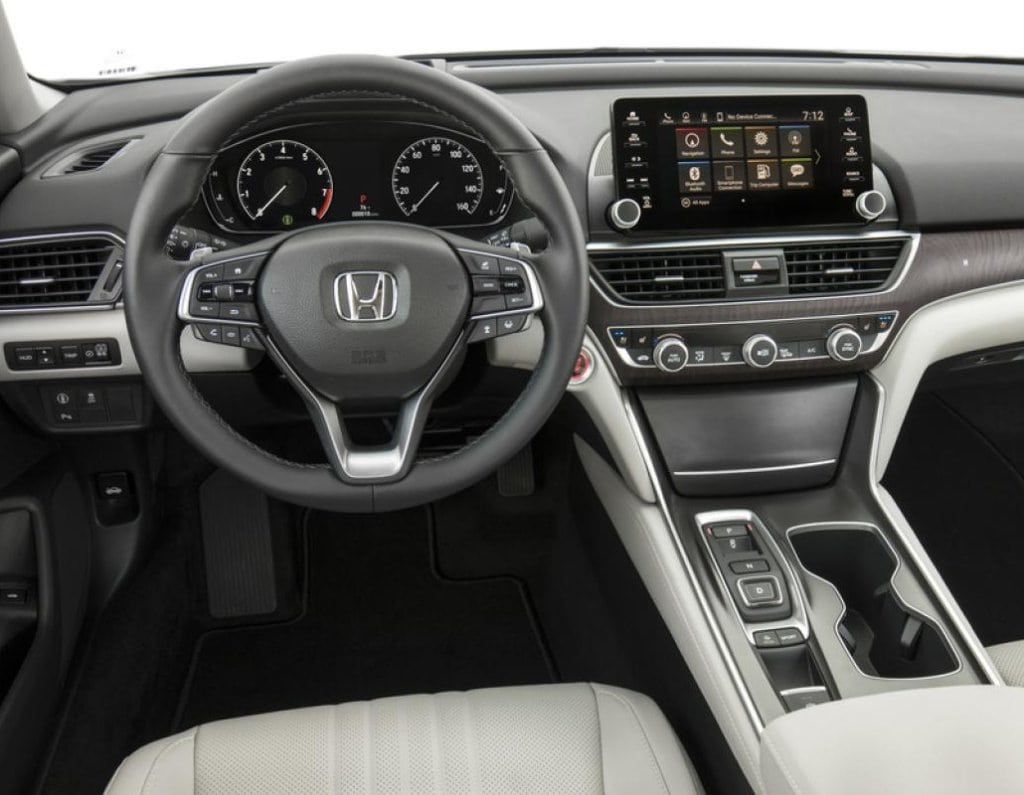
Manufacturers use In-mold technology across a wide range of industries:
- Consumer electronics housings
- Automotive interior trim panels
- Medical device enclosures
- Home appliance control panels
- Industrial control interfaces
In each case, in-mold decoration (IMD) improves product longevity and visual consistency.
Why Polar Printed Electronics specializes in In-mold technology
At Polar Printed Electronics, In-mold technology is engineered as a complete solution. From IMD film selection to process optimization, every step focuses on quality, repeatability, and performance.
By combining polycarbonate film, hard-coated film, precision printing, and controlled overmolding, Polar Printed Electronics delivers IMD components ready for demanding applications.
Conclusion
In-mold technology represents a smarter approach to component decoration and protection. By integrating design and durability into a single process, manufacturers reduce complexity while improving product performance.
With advanced IMD film, reliable film insert molding, and proven in-mold decoration (IMD) expertise, Polar Printed Electronics supports OEMs seeking durable, high-quality, and visually refined components.
