
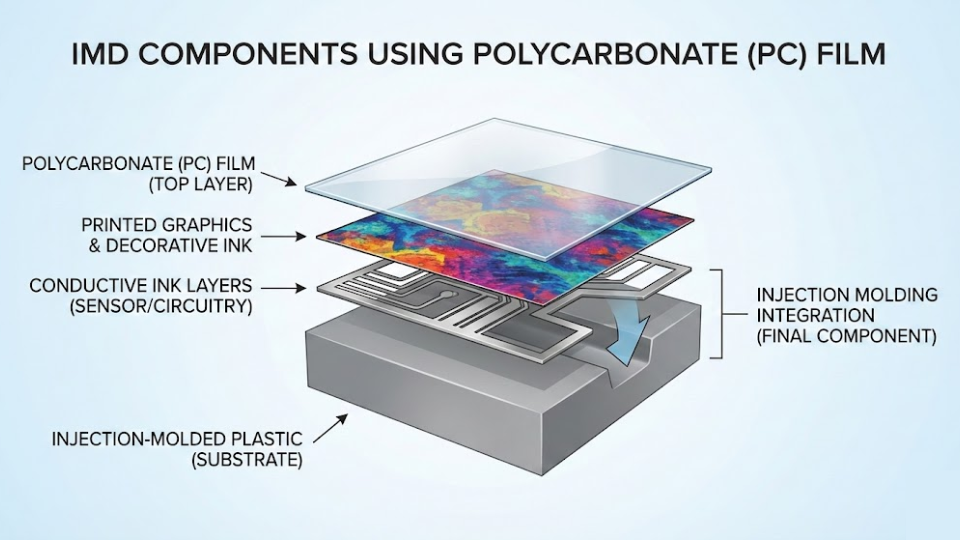
Polycarbonate (PC) film plays a central role in modern IMD components and printed electronics because it combines durability, clarity, and thermal stability in a single material. In IMD technology, the printed film becomes an integral part of the molded component. Therefore, selecting the right substrate, ink, and protective coating directly determines product performance, reliability, and visual quality. At Linepro Controls, engineers carefully select PC film, PET film, and advanced coatings to deliver long-lasting and high-performance IMD solutions.
This blog explains how Polycarbonate (PC) film, PET film, conductive inks, and protective coatings work together to create robust IMD components with excellent scratch resistance, chemical resistance, and long-term color stability.
Why Material Selection Is Critical in IMD and Printed Electronics
IMD technology integrates decoration and functionality directly into molded plastic parts. As a result, the selected IMD film must tolerate heat, pressure, and mechanical stress during molding. In addition, the material must protect printed circuits and graphics throughout the product’s life.
Moreover, IMD components often appear in control panels, appliances, automotive interiors, and consumer electronics. Therefore, materials must deliver consistent performance under repeated use and environmental exposure.
Key material requirements include:
- Scratch resistance
- Chemical resistance
- UV resistance
- Dimensional stability
- Electrical reliability
Each requirement influences the choice of film substrates, inks, and protective coatings.
Polycarbonate (PC) Film: The Core Material for IMD Components
Polycarbonate (PC) film remains the preferred substrate for high-performance IMD applications. Unlike standard films, PC film delivers a balanced combination of mechanical strength, optical clarity, and thermal resistance.
Key Advantages of Polycarbonate (PC) Film
First, PC film offers excellent impact resistance. This property allows control panels and graphic overlays to withstand repeated handling without cracking or deformation.
Second, PC film provides outstanding optical clarity. Consequently, printed graphics remain sharp, vibrant, and visually consistent. This directly supports long-term color stability, which is essential for branded interfaces.
Additionally, PC film resists high processing temperatures. Since IMD involves injection molding, this thermal stability prevents distortion and dimensional changes.
Finally, PC film supports strong adhesion with conductive ink, silver ink, and protective coatings. As a result, printed electronics maintain electrical performance over time.
PET Film: A Cost-Effective Alternative for IMD Applications
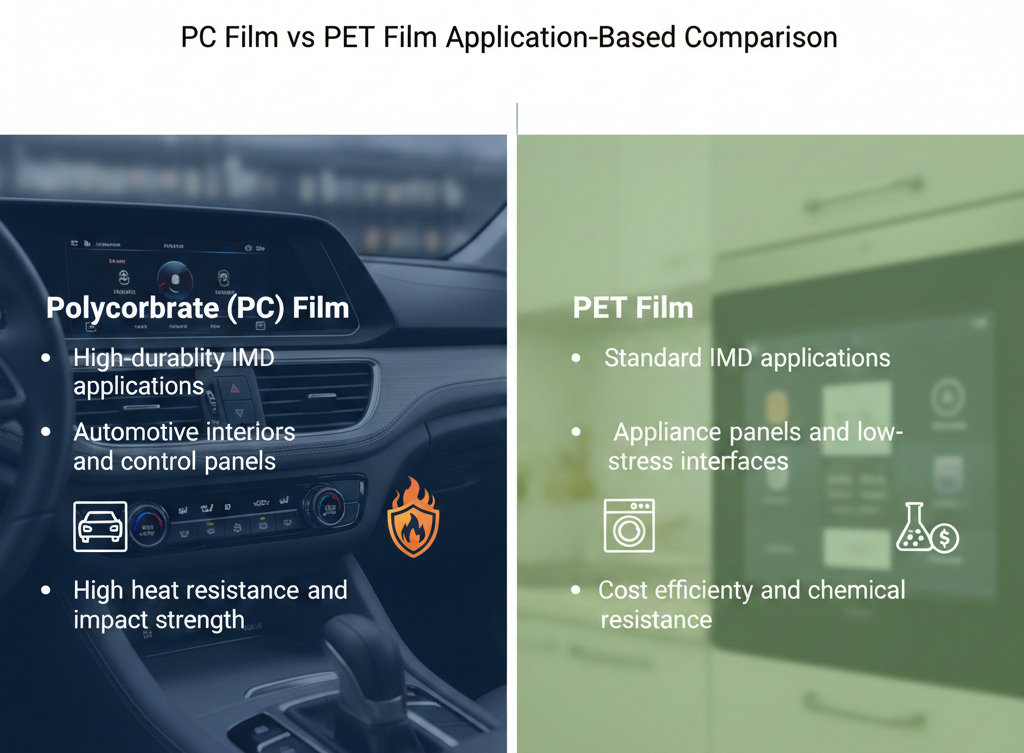
PET film also plays an important role in printed electronics and IMD components. Manufacturers often select PET film when applications require moderate durability at a lower material cost.
Benefits of PET Film
- Good chemical resistance
- Stable printing surface
- Smooth finish for decorative film
- Cost efficiency for large volumes
However, PET film offers lower impact resistance and heat tolerance than Polycarbonate film. Therefore, PET alone may not suit high-stress or premium IMD applications.
PC-PET Composite Film: Combining Strength and Efficiency

To balance performance and cost, many manufacturers choose PC-PET composite film. This layered structure combines the advantages of both materials.
The PC layer delivers durability, clarity, and thermal stability. Meanwhile, the PET layer improves stiffness and cost efficiency. Consequently, PC-PET composite film performs well in demanding IMD environments without unnecessary material expense.
Furthermore, composite films improve dimensional stability during molding. This reduces print distortion and ensures consistent final part quality.
Conductive Ink and Silver Ink in Printed Electronics
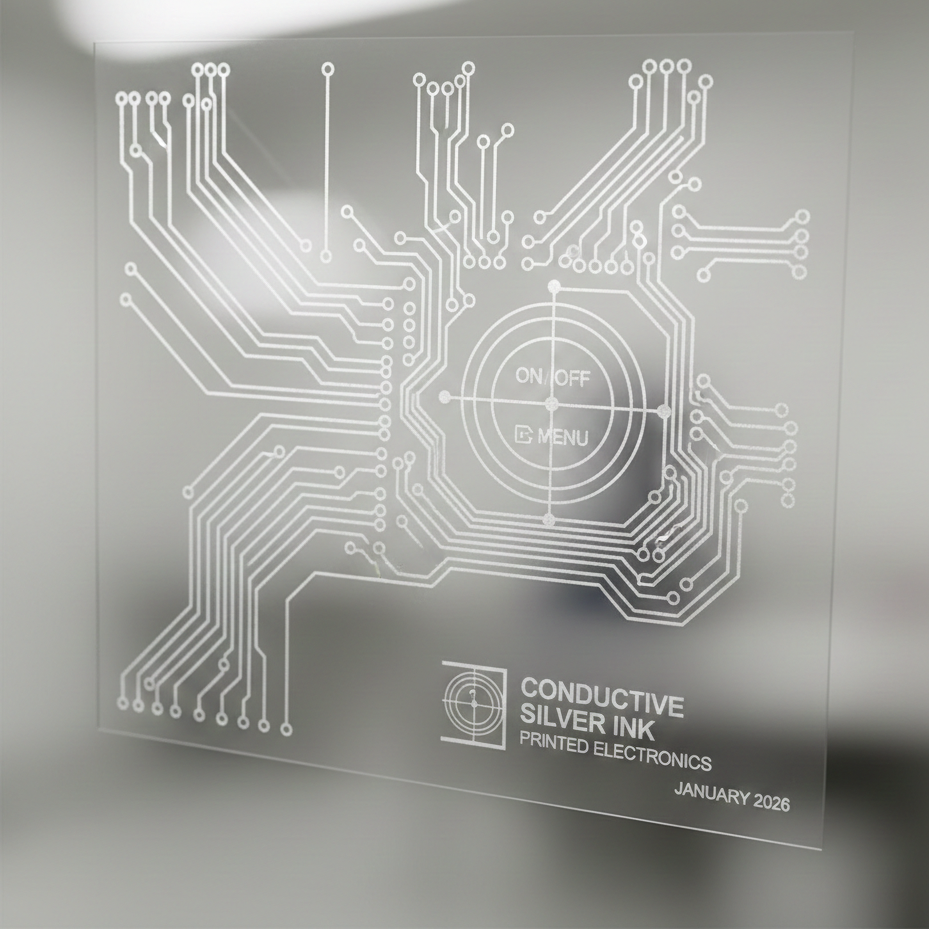
Conductive ink enables functional circuitry in IMD components. Among available options, silver ink remains the most reliable choice.
Why Silver Ink Performs Best
Silver ink provides excellent electrical conductivity. Therefore, it supports accurate signal transmission and responsive touch interfaces. In addition, silver ink adheres well to both PC film and PET film when surface treatments are applied correctly.
Moreover, silver ink allows fine-line printing. This capability supports compact designs and advanced human–machine interfaces in modern printed electronics.
Protective Coatings for IMD Film Durability
Protective coatings play a crucial role in extending the lifespan of IMD components. These coatings protect decorative and conductive layers from wear and environmental damage.
Hard-Coated Film for Scratch Resistance
A hard-coated film improves surface hardness and reduces visible wear. As a result, touch panels and graphic overlays maintain a premium appearance even after extensive use.
UV-Resistant Film for Long-Term Color Stability
Sunlight exposure can fade printed graphics. Therefore, UV-resistant film coatings protect colors and prevent material degradation. This ensures consistent appearance and performance over time.
Chemical Resistance for Harsh Environments
Many IMD components face exposure to cleaning agents, oils, and moisture. Chemical-resistant coatings prevent ink damage and protect printed circuits, especially in industrial and consumer applications.
How to Select the Right IMD Material Combination
Effective material selection starts with application analysis.
First, evaluate environmental exposure. If the product faces heat, UV light, or chemicals, PC film with UV-resistant and hard-coated layers delivers the best performance.
Next, assess mechanical demands. High-touch or impact-prone interfaces benefit from Polycarbonate or PC-PET composite films.
Then, match conductive ink selection to the substrate to ensure reliable printed electronics functionality.
Finally, balance performance and cost by selecting composite structures when appropriate.
Application Example: IMD Graphic Overlay for Control Panels
In an industrial control panel application:
- Polycarbonate (PC) film provides impact resistance and clarity
- Silver conductive ink forms durable touch circuits
- A hard-coated, UV-resistant film protects against wear and fading
As a result, the IMD component delivers excellent usability, durability, and visual quality throughout its service life.
Conclusion: Polycarbonate (PC) Film Enables Reliable IMD Performance
Material selection defines the success of IMD components. Polycarbonate (PC) film forms the foundation of durable, high-quality IMD designs. When engineers combine PC film with PET film, PC-PET composite film, advanced conductive inks, and protective coatings, they achieve superior performance and long-term reliability.
At Linepro Controls, strategic material selection ensures every IMD film, decorative film, and graphic overlay film meets demanding functional and aesthetic requirements—today and for years to come.
