
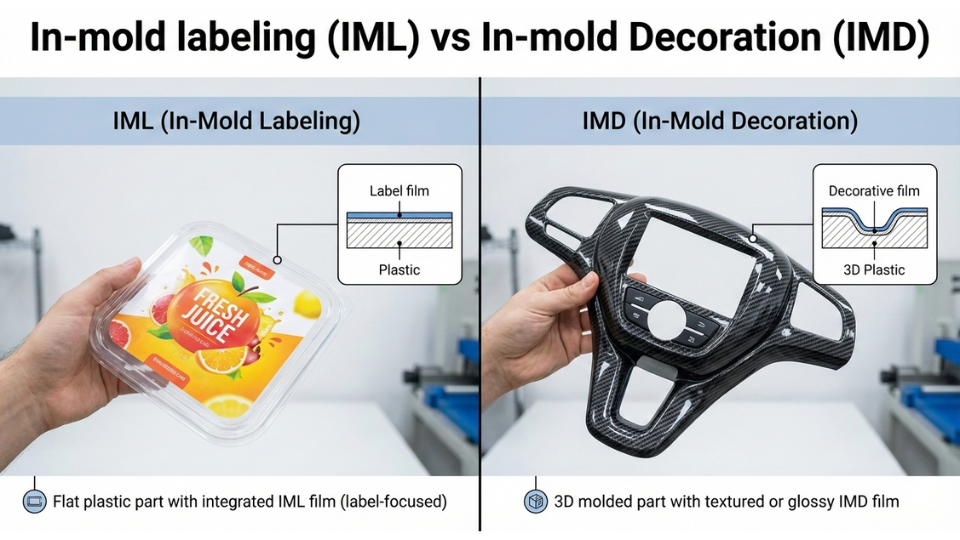
Therefore, manufacturers increasingly adopt In-mold labeling (IML) and In-mold decoration (IMD) to achieve high-quality finishes with fewer production steps. As industries push for efficiency and consistency, in-mold technology has become a preferred alternative to traditional post-molding decoration methods.
Although both processes rely on similar principles, their applications and capabilities differ. Hence, understanding the process basics of In-mold labeling (IML) vs In-mold decoration (IMD) helps manufacturers select the right solution. At Polar Printed Electronics, we support advanced film insert molding solutions that combine functionality, durability, and design freedom.
What Is In-mold Labeling (IML)?
In-mold labeling (IML) is a one-step decoration process where a pre-printed film is placed inside the injection mold before plastic injection begins. When molten resin enters the mold, it bonds permanently with the IML film, creating a single integrated component.
As a result, the label becomes part of the molded product instead of a surface-applied element. Consequently, In-mold labeling (IML) delivers long-lasting graphics, superior resistance to wear, and excellent surface quality.
In-mold Labeling (IML) Process Basics
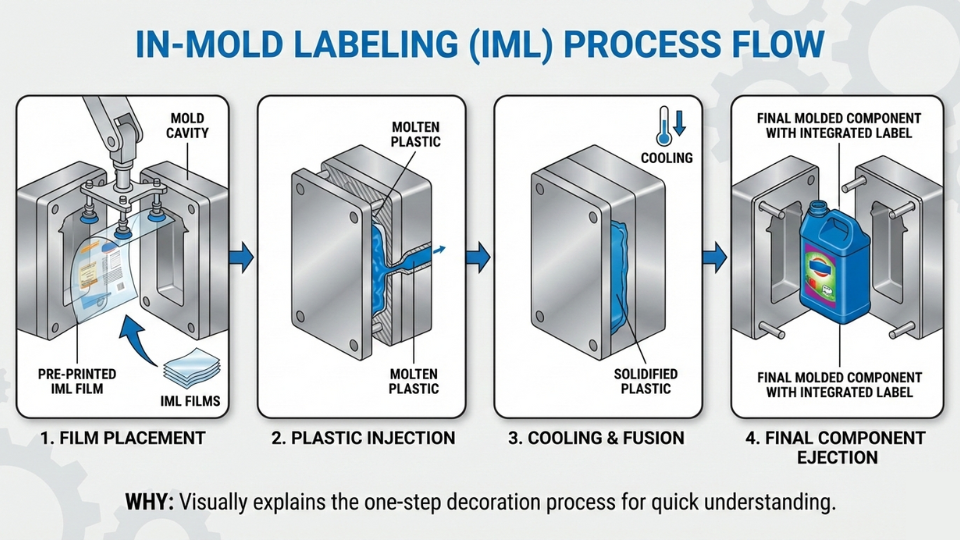
First, manufacturers print graphics on a pre-printed film using offset, digital, or screen printing.
Next, the IML film is cut and positioned accurately inside the mold cavity.
Then, molten plastic flows behind the film during injection molding.
Finally, the film fuses with the substrate as the part cools.
Because decoration and molding occur simultaneously, IML enables high-volume production while maintaining consistent quality and repeatability.
What Is In-mold Decoration (IMD)?
In-mold decoration (IMD) is an advanced injection molding decoration technique that integrates decorative and protective layers into the molded part. Unlike IML, IMD films often include multiple layers, such as graphics, textures, hard coats, and surface protection.
Moreover, IMD supports complex geometries through overmolding, which allows manufacturers to create visually rich and durable components. Therefore, IMD is widely used in automotive interiors, consumer electronics housings, and industrial control panels.
In-mold Decoration (IMD) Process Basics
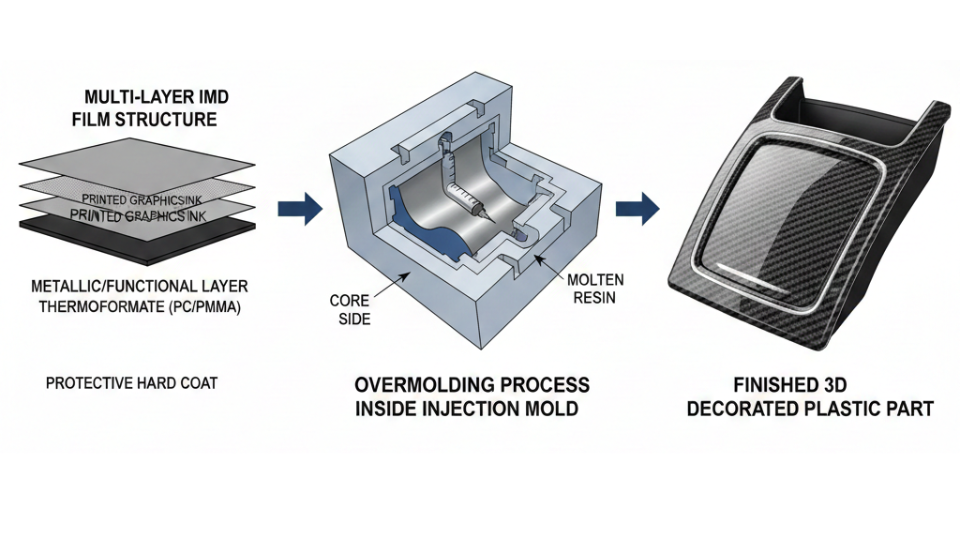
Initially, manufacturers print and form a multi-layer IMD film.
After that, the formed film is placed inside the injection mold.
Subsequently, molten plastic is injected behind the film.
Finally, trimming may occur depending on part geometry.
Since IMD integrates decoration and protection in one cycle, it provides true one-step decoration with excellent surface performance.
IMD vs In-mold Labeling (IML): Key Process Differences
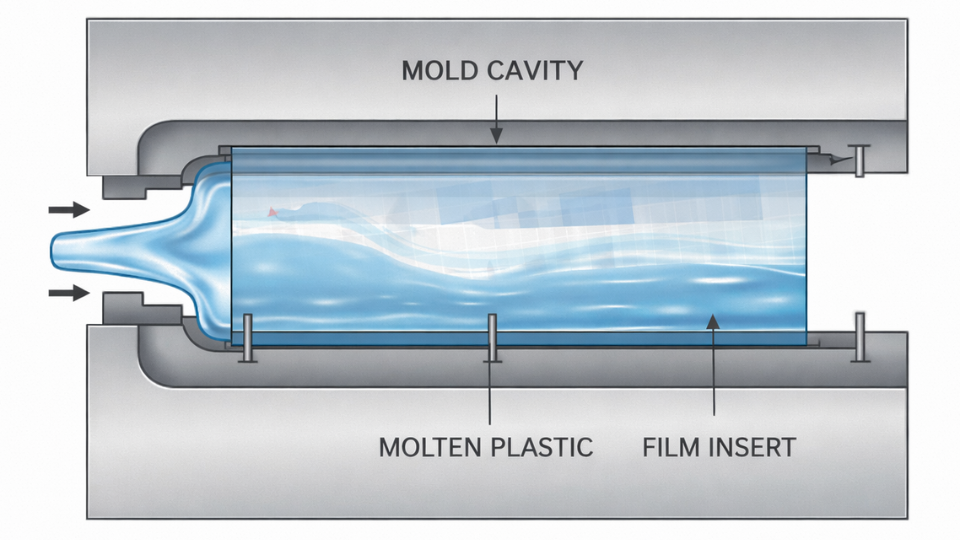
Although both methods use film insert molding, their objectives and outcomes vary.
Film Structure
- IML film: Thin, label-focused, and primarily graphic-based
- IMD film: Multi-layered with decorative and functional properties
Design Flexibility
- In-mold labeling (IML) suits flat or mildly curved surfaces.
- In-mold decoration (IMD) supports complex 3D shapes and textures.
Functional Capabilities
- IML focuses mainly on branding and information display.
- IMD enables protective coatings and functional surface integration.
Post-Processing
- IML typically requires no trimming.
- IMD may involve trimming depending on design requirements.
Injection Molding Decoration and Manufacturing Efficiency
Traditional decoration methods often involve painting, printing, or labeling after molding. However, these processes increase production time and cost. In contrast, injection molding decoration using IMD or IML simplifies manufacturing.
As a result, manufacturers benefit from:
- Elimination of secondary painting
- Reduced labor and material waste
- Improved process consistency
- Faster production cycles
Because the decoration becomes part of the molded component, the finished product exits the mold ready for use.
Advantages of In-mold Labeling (IML)
In-mold labeling (IML) works best for applications that demand consistent branding and long-term durability.
Key Benefits of IML
- Seamless integration of labels
- High-resolution, permanent graphics
- Strong resistance to moisture and chemicals
- Cost-effective for high-volume production
- Improved recyclability due to material compatibility
Therefore, IML is commonly used in packaging, consumer goods, and industrial enclosures.
Advantages of In-mold Decoration (IMD)
IMD offers enhanced design freedom and surface performance.
Key Benefits of In-mold Decoration (IMD)
- High-gloss, matte, or textured finishes
- Scratch and UV resistance
- Functional layer integration
- Fewer assembly steps
- Extended product lifespan
Consequently, IMD is ideal for automotive interiors, medical devices, and electronic housings.
IMD vs IML: Application Comparison
| Application Area | In-mold Labeling (IML) | In-mold Decoration (IMD) |
| Packaging | ✅ Ideal | ❌ Limited |
| Consumer Electronics | ⚠️ Limited | ✅ Ideal |
| Automotive Interiors | ❌ Rare | ✅ Preferred |
| Industrial Components | ✅ Common | ✅ Common |
| Branding & Graphics | ✅ Excellent | ✅ Excellent |
This comparison highlights how IML film supports branding-driven applications, while IMD film enables complex and premium designs.
Why In-mold Technology Is Replacing Traditional Methods
Compared to conventional finishing processes, in-mold technology improves efficiency and reliability. Since decoration and molding occur together, manufacturers reduce defects and improve output consistency.
Additionally, pre-printed film solutions support sustainable manufacturing by reducing paint usage and material waste. Therefore, IMD and IML continue to replace traditional decoration techniques across industries.
In-mold Labeling (IML) and IMD at Polar Printed Electronics
At Polar Printed Electronics, we deliver precision-driven In-mold labeling IML and (IMD) solutions tailored for industrial and electronic applications.
Our capabilities include:
- Custom IML film and IMD film development
- Advanced film insert molding
- Reliable overmolding processes
- Scalable high-volume production
By combining technical expertise with innovative materials, we help manufacturers achieve durable, high-quality, and visually striking components.
Conclusion: In-mold Labeling (IML) vs IMD
In conclusion, the choice between In-mold labeling (IML) and In-mold decoration (IMD) depends on design complexity, functional requirements, and production volume. While IML offers cost-effective and durable labeling, IMD delivers advanced aesthetics and surface functionality.
As in-mold technology continues to evolve, both processes will remain essential for modern manufacturing. With the right partner, manufacturers can achieve efficiency, durability, and design excellence in a single molding cycle.
